
GPT-5.4 vs Claude Sonnet 4.6: Which Is Better for AI Agents and Automation?
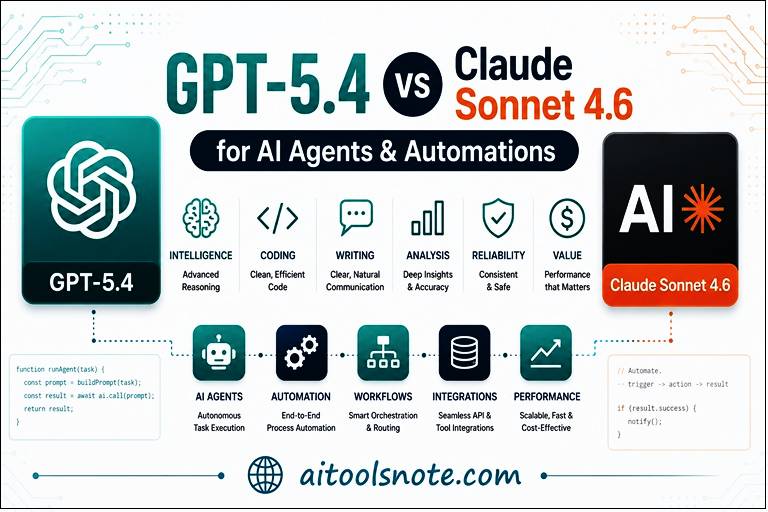 Choosing an AI model for chat is easy. Choosing an AI model for agents and automation is harder. A chatbot can answer and stop. An AI agent has to plan, call tools, read files, use APIs, make decisions, and sometimes continue work across multiple steps. That is where the choice between GPT-5.4 and Claude Sonnet 4.6 becomes important.
GPT-5.4 is a better choice if you want a model deeply connected to OpenAI’s agent stack, built-in tools, tool search, computer use, and structured automation workflows. Claude Sonnet 4.6 is a strong choice if you want reliable coding automation, long-context work, Claude Code workflows, MCP-based tool connections, and a balanced speed-to-intelligence model.
For most product automation teams, GPT-5.4 is easier to build around. For many developer coding workflows, Claude Sonnet 4.6 feels more natural.
Why This Comparison Matters
AI agents are no longer simple chatbots. They can update tickets, inspect codebases, browse files, call APIs, review pull requests, run tests, and trigger workflows. A wrong model choice can increase cost, reduce reliability, or create unsafe automation. This comparison helps you choose based on real work, not only model popularity.
GPT-5.4 Overview
GPT-5.4 is OpenAI’s more affordable frontier model for coding and professional work. According to OpenAI’s model documentation, the model ID is gpt-5.4.
OpenAI lists GPT-5.4 with:
- 1M token context window
- 128K max output tokens
- Fast latency
- Text and image input
- Text output
- Reasoning levels from none to xhigh
- Function calling
- Web search
- File search
- Computer use
OpenAI’s tools documentation also says that when building agents, developers can extend models with built-in tools, function calling, tool search, and remote MCP servers. It specifically notes that only gpt-5.4 and later models support tool_search.
That last point matters for automation.
Tool search means the model can load relevant tools dynamically instead of putting every possible tool definition into the prompt. For large agent systems, this can reduce prompt clutter and improve routing.
GPT-5.4 is not the newest OpenAI model at the time of writing. OpenAI’s docs list GPT-5.5 as the flagship model. But GPT-5.4 still makes sense when you want strong agent capability at lower cost than the latest top model.
Claude Sonnet 4.6 Overview
Claude Sonnet 4.6 is Anthropic’s balanced model in the Claude 4 family. Anthropic describes Claude Sonnet 4.6 as “the best combination of speed and intelligence.” Its API model ID is claude-sonnet-4-6.
Claude Sonnet 4.6 is especially relevant because it sits close to Claude Code and Anthropic’s tool ecosystem.
Anthropic’s documentation says Claude Code is an agentic coding tool that can:
- Read your codebase
- Edit files
- Run commands
- Integrate with development tools
- Work in terminal, IDE, desktop app, and browser
Claude Code can also automate common developer work such as writing tests, fixing lint errors, resolving merge conflicts, updating dependencies, creating commits, opening pull requests, and reviewing changed files for security issues.
For developers, this is a serious advantage.
Claude Sonnet 4.6 also supports tool use through Claude API. Anthropic explains that Claude can call client-side tools that your app executes, or server-side tools that Anthropic executes. Claude supports web search, web fetch, code execution, memory, bash, computer use, text editor tools, and MCP connections.
GPT-5.4 vs Claude Sonnet 4.6 Comparison Table
| Feature | GPT-5.4 | Claude Sonnet 4.6 |
|---|---|---|
| Provider | OpenAI | Anthropic |
| Model ID | gpt-5.4 | claude-sonnet-4-6 |
| Best for | Product agents, automation systems, tool-heavy workflows | Coding agents, long-context development work, Claude Code automation |
| Context window | 1M tokens | 1M tokens |
| Max output | 128K tokens | Up to 300K output tokens in Message Batches with beta header |
| Input price | $2.50 / million tokens | $3 / million tokens |
| Output price | $15 / million tokens | $15 / million tokens |
| Built-in tools | Web search, file search, computer use, function calling, tool search, MCP | Web search, web fetch, code execution, bash, memory, computer use, text editor, MCP |
| Agent framework | OpenAI Agents SDK | Claude Code and Claude Agent SDK |
| Human approval support | Strong in OpenAI Agents SDK | Strong through Claude Code permissions and workflow controls |
| Best user type | Product teams, automation builders, AI app developers | Developers, coding teams, engineering automation users |
GPT-5.4 vs Claude Sonnet 4.6 for AI Agents
If your main goal is to build AI agents inside your own product, GPT-5.4 has a strong advantage.
OpenAI’s Agents SDK is designed for applications that plan, call tools, collaborate across specialist agents, and maintain state for multi-step work. OpenAI also documents clear support for orchestration, tool execution, approvals, state, guardrails, tracing, and evaluation.
That makes GPT-5.4 a good fit for agents such as:
- Customer support agents
- Research agents
- Sales operations agents
- Data analysis agents
- Workflow routing agents
- Internal knowledge assistants
- Multi-tool productivity agents
A typical GPT-5.4 agent workflow may look like this:
- Read the user request.
- Decide whether a tool is needed.
- Search documents or the web.
- Call a business API.
- Validate the output.
- Ask for human approval if needed.
- Complete the task.
OpenAI’s guardrails documentation is also useful here. It supports input guardrails, output guardrails, tool guardrails, and human-in-the-loop approvals. For sensitive workflows, such as cancelling an order or changing account data, the agent can pause until a person approves the action.
Verdict: GPT-5.4 is better for product-grade AI agents where orchestration, safety checks, approvals, and tool routing are important.
GPT-5.4 vs Claude Sonnet 4.6 for Automation
For general automation, the answer depends on what kind of automation you mean.
If you are automating business workflows, GPT-5.4 is often easier to build around because OpenAI’s platform gives you a broad toolkit in one place: Responses API, Agents SDK, function calling, hosted tools, MCP, file search, web search, and computer use.
For example, GPT-5.4 is a good fit for:
- Auto-summarizing customer tickets
- Updating CRM records
- Generating weekly reports
- Searching internal documents
- Routing support requests
- Triggering approval workflows
- Building multi-agent assistants
Claude Sonnet 4.6 becomes more attractive when automation is closer to development work.
For example, Claude Sonnet 4.6 is a good fit for:
- Writing tests
- Fixing lint errors
- Updating dependencies
- Reviewing pull requests
- Refactoring code
- Creating release notes
- Running CI-related checks
- Working across a large codebase
Claude Code also supports automation through CLI workflows. Anthropic gives examples such as piping logs into Claude, reviewing changed files, translating strings in CI, and raising pull requests.
Verdict: Use GPT-5.4 for general business automation. Use Claude Sonnet 4.6 when your automation lives inside code, Git, terminal, IDE, or CI/CD workflows.
Best Model for Coding Agents
Claude Sonnet 4.6 has a clear strength in coding workflows because of Claude Code.
Claude Code is not just a chat interface. It is built to work inside a real development environment. It can read files, edit code, run commands, manage projects, use MCP servers, remember project instructions through CLAUDE.md, and work across terminal, IDE, desktop, and web surfaces.
This makes Claude Sonnet 4.6 attractive for developers who want an AI coding agent that can work like a project-aware assistant.
A good Claude Code task may look like this:
Review the authentication module.
Find missing tests, add JUnit tests for uncovered service methods,
run the test suite, fix failures, and prepare a pull request summary.
GPT-5.4 can also handle coding very well, especially inside OpenAI’s coding and agent ecosystem. It supports computer use, file search, function calling, and agent workflows. But if the main use case is developer automation, Claude’s dedicated coding environment gives Sonnet 4.6 a strong practical edge.
Verdict: Claude Sonnet 4.6 is better for coding agents. GPT-5.4 is better when coding is only one part of a larger product automation system.
Pricing: Which One Is Cheaper?
Based on official pricing pages:
| Pricing Item | GPT-5.4 | Claude Sonnet 4.6 |
|---|---|---|
| Input tokens | $2.50 / MTok | $3 / MTok |
| Output tokens | $15 / MTok | $15 / MTok |
| Context window | 1M | 1M |
| Prompt caching | Available through OpenAI platform features | Cache hits at $0.30 / MTok for Sonnet 4.6 |
| Batch discount | OpenAI has batch/flex options by platform | Anthropic Batch API gives 50% discount |
GPT-5.4 has a slightly lower base input price. Output pricing is the same.
However, real cost depends on your workflow. Agent systems often spend many tokens on tool schemas, logs, file content, intermediate reasoning, and retries. Claude’s prompt caching can be useful when you repeatedly send the same large instructions or project context. OpenAI’s tool search can reduce loaded tool definitions in large tool environments.
Practical advice: Do not choose only by base token price. Run a small benchmark using your real tasks.
Try This: Simple Benchmark Prompt
Use this prompt with both models before choosing:
You are an AI automation agent.

Task:
Analyze the following workflow and propose an implementation plan.

Workflow:
A customer support ticket arrives.
The agent must classify the issue, search internal docs,
draft a reply, decide whether refund approval is needed,
and create a CRM note.

Requirements:
- Identify required tools.
- Show step-by-step agent flow.
- Mention human approval points.
- Mention failure cases.
- Suggest evaluation metrics.

Return the answer as:
1. Agent design
2. Tool list
3. Safety checks
4. Evaluation plan
Then compare:
- Which model identifies better tools?
- Which model handles approval points better?
- Which model gives clearer failure cases?
- Which output is easier to implement?
- Which one costs less for your expected workload?
Pros and Cons of GPT-5.4
Pros
- Strong OpenAI agent ecosystem
- Supports tool search
- Good for product automation
- Lower base input price than Claude Sonnet 4.6
- Strong built-in tool support
- Good guardrails and human approval patterns
- 1M context window
Cons
- GPT-5.5 exists as OpenAI’s newer flagship option
- Tool-heavy workflows still need careful design
- Computer use and automation can create safety risks if approvals are weak
- Best results require strong evals and observability
Pros and Cons of Claude Sonnet 4.6
Pros
- Strong coding agent experience through Claude Code
- Balanced speed and intelligence
- 1M context support
- Good for long codebase tasks
- Strong MCP-based tool connectivity
- Useful CLI, IDE, desktop, and browser workflows
- Good fit for developer automation
Cons
- Slightly higher base input price than GPT-5.4
- Claude Fable 5 and Opus 4.8 exist for higher capability use cases
- Product teams may need more custom orchestration depending on architecture
- Tool use still requires careful permission and security controls
Common Mistakes to Avoid
Mistake#1: Choosing Only by Benchmark Scores
Benchmarks are helpful, but agents fail in real workflows because of tool design, permissions, bad context, and weak evaluation. Test your own workflows.
Mistake#2: Ignoring Human Approval
Any agent that can change data, run commands, send messages, or update systems needs approval rules. OpenAI and Anthropic both support safer patterns, but you must design them properly.
Mistake#3: Sending Too Much Context Every Time
A 1M context window is useful, but it is not a reason to dump everything into every request. Use retrieval, caching, summaries, and tool search where possible.
Mistake#4: Treating Coding Agents Like Chatbots
A coding agent needs repository rules, test commands, style guides, permission boundaries, and clear rollback instructions. Without that, even a strong model can create messy changes.
Mistake#5: Skipping Evaluation
For automation, you need test cases. Track success rate, tool-call accuracy, cost per task, approval frequency, latency, and failure recovery.
Final Recommendation
Choose GPT-5.4 if you are building AI agents inside a product or business workflow. It is especially strong when you need OpenAI Agents SDK, tool search, structured orchestration, built-in tools, guardrails, and human review.
Choose Claude Sonnet 4.6 if you are focused on coding agents, development automation, CI/CD workflows, pull request review, refactoring, and long codebase work. Claude Code makes it feel very practical for engineering teams.
If your company is building both, the best answer may be hybrid:
- GPT-5.4 for customer-facing or internal business agents
- Claude Sonnet 4.6 for developer automation and coding agents
The smartest approach is not “which model is best overall?” The better question is: which model is best for this exact workflow, with this tool setup, this budget, and this risk level?
FAQs (People Also Ask)
Is GPT-5.4 better than Claude Sonnet 4.6?
GPT-5.4 is better for many product AI agents and general automation workflows because of OpenAI’s agent tooling, tool search, built-in tools, and guardrail support. Claude Sonnet 4.6 is often better for coding automation because of Claude Code and its developer-focused workflow.
Is Claude Sonnet 4.6 good for AI agents?
Yes. Claude Sonnet 4.6 is good for AI agents, especially coding agents and workflows connected to Claude Code, MCP, terminal commands, IDEs, and CI/CD. For broad business automation, compare it carefully with GPT-5.4 using your own tasks.
Which model is cheaper for automation?
GPT-5.4 has a lower base input price at $2.50 per million tokens, while Claude Sonnet 4.6 costs $3 per million input tokens. Both list $15 per million output tokens. Real cost depends on context size, tool schemas, caching, batch usage, and retries.
What to Explore Next
After comparing GPT-5.4 vs Claude Sonnet 4.6, explore these topics:
- How to build AI agents with OpenAI Agents SDK
- How to use Claude Code for coding automation
- What is MCP and why it matters for AI tools
- AI agent safety checklist
- Prompt caching for long-context workflows
- How to evaluate AI agents before production
References
- OpenAI Models Documentation
- OpenAI Using Tools Documentation
- OpenAI Agents SDK Documentation
- OpenAI Guardrails and Human Review
 Claude Models Overview
- Claude Tool Use Documentation
- Claude Code Overview
You may also go through:
How to create a Custom AI Agent: A Comprehensive Guide
How to Build an AI Research Workflow Using ChatGPT and NotebookLM (2026)