
Open-Context Prompts vs Closed-Context Prompts
 When working with AI models like ChatGPT, the way you ask a question (prompt) decides the quality of the answer.
Prompts can be broadly divided into two types:
-
Open-Context Prompts: Creative, subjective, and allow multiple valid answers.
-
Closed-Context Prompts: Factual, objective, and allow only one correct (or very few correct) answers.
Understanding these two types will help you write better prompts and get more accurate results from AI.
What Are Open-Context Prompts?
An open-context prompt gives the AI freedom to be creative. The answer may vary every time you ask.
Open-context prompts are instructions or questions given to an AI without restricting the scope of its answer. The AI has freedom to generate responses based on its training data, creativity, or general knowledge.
These prompts are like saying to a human: “Tell me whatever you think about this topic.” The boundaries are broad, so the answer can take many directions.
Characteristics:
-
Multiple possible answers
-
Creative and subjective
-
Useful for brainstorming, writing, idea generation
Examples:
-
“Write a haiku about a cat.”
-
“Describe a futuristic city.”
-
“Generate 5 startup ideas in the healthcare industry.”
-
“Write a story about a dragon who wants to become a chef.”
-
“Generate three startup ideas using AI in healthcare.”
- “What are some ways humans might live on Mars in the future?”
Notice how none of these limit the AI to a fixed formula, the response depends on creativity and imagination.
What Are Closed-Context Prompts?
A closed-context prompt has one correct answer or a limited set of correct answers.
Closed-context prompts are instructions that give the AI a specific task with clear boundaries. The answer is usually factual, structured, or calculated.
These are like asking a human: “Please solve this math problem” or “Summarize this specific book.” There is little room for creativity — the goal is to get an accurate, concise response.
Characteristics:
-
Objective and factual
-
Predictable answer
-
Useful for calculations, factual Q&A, and summarization
Examples:
-
“What is 25 × 8?”
-
“Summarize the plot of the novel Around the World in 80 Days.”
-
“How many planets are in our solar system?”
- “Calculate the area of a triangle with base 5 cm and height 8 cm.”
Notice how all these limit the AI’s response to a specific context with an expected outcome.
Key Differences Between Open vs Closed Prompts
Here’s how they compare:
| Aspect | Open-Context Prompt | Closed-Context Prompt |
|---|---|---|
| Definition | Multiple valid answers | One or few correct answers |
| Nature of Answers | Creative, subjective, varied | Factual, specific, consistent |
| Examples | “Write a poem about a cat.” | “What is 5 + 7?” |
| Best Use Cases | Creativity, brainstorming, storytelling | Problem-solving, factual queries |
When to Use Which?
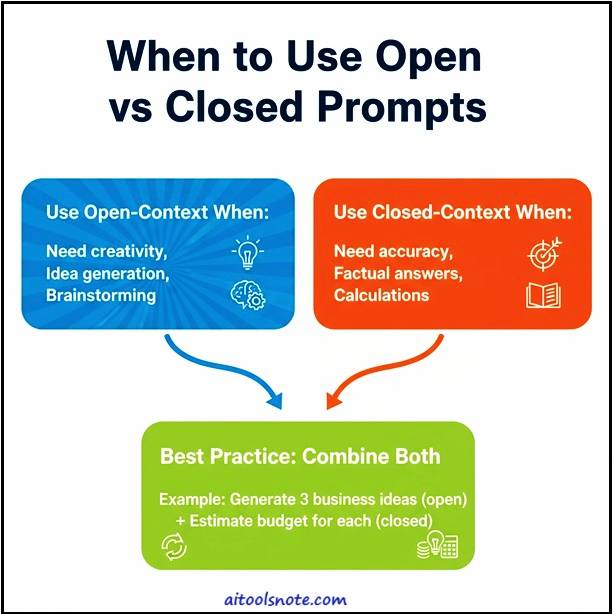
When to Use Open-Context Prompts:
-
Creative Projects
-
Story writing
-
Idea generation
-
Conceptual design
-
-
Strategic Planning
-
Business strategy
-
Research proposals
-
Problem-solving
-
-
Complex Analysis
-
Market trends
-
Societal impacts
-
Ethical considerations
-
-
Learning and Exploration
-
Understanding complex topics
-
Connecting disparate ideas
-
Developing new perspectives
-
When to Use Closed-Context Prompts:
-
Information Retrieval
-
Fact-checking
-
Data lookup
-
Definitions and explanations
-
-
Technical Tasks
-
Calculations
-
Code generation
-
Formatting instructions
-
-
Structured Queries
-
Database searches
-
API requests
-
Command execution
-
-
Educational Contexts
-
Quiz questions
-
Test preparation
-
Quick references
-
In real-world applications, we often combine both. For example:
“Give me 3 business ideas (open-context) and calculate the estimated budget for each (closed-context).”
Pros & Cons
Open-Context Prompts
Pros: Creative, flexible, inspiring
Cons: Unpredictable, sometimes irrelevant
Closed-Context Prompts
Pros: Accurate, reliable, factual
Cons: Limited scope, less creative
Real-World Applications
Open-Context Prompts are great for:
-
Creative writing (poems, stories, lyrics)
-
Marketing copy
-
Brainstorming new ideas
-
Art generation
- Exploring possibilities or open-ended questions
Closed-Context Prompts are great for:
-
Math/science questions
-
Generating summaries
-
Coding tasks
-
Factual Q&A
-
Performing calculations
- Writing structured explanations
Best Practices for Each Approach
Crafting Effective Closed-Context Prompts:
-
Be Specific: Clearly define what you need
-
Use Precise Language: Avoid ambiguous terms
-
Set Clear Parameters: Define scope and limitations
-
Include Examples: When appropriate, show desired format
Crafting Effective Open-Context Prompts:
-
Establish Clear Objectives: Define what you want to achieve
-
Provide Adequate Context: Include relevant background information
-
Set Boundaries: While keeping it open, establish some guidelines
-
Encourage Exploration: Use language that promotes creative thinking
Hybrid Approaches
In practice, many effective prompts combine elements of both approaches:
Example Hybrid Prompt:
“Explain the concept of machine learning (closed-context element) and discuss three potential applications that could transform healthcare in the next five years (open-context element).”
This hybrid approach provides structure while allowing for creative exploration, offering the best of both worlds in many scenarios.
Conclusion
Both open-context and closed-context prompts have valuable roles in human-AI interaction. The choice between them depends on your specific needs:
-
Choose closed-context prompts when you need precise, reliable information quickly
-
Choose open-context prompts when you’re exploring ideas, seeking creativity, or dealing with complex, nuanced topics
-
Consider hybrid approaches for balanced tasks requiring both structure and flexibility
As AI technology continues to advance, the ability to effectively use both prompting strategies will become an increasingly valuable skill. The most successful AI interactions will likely involve knowing when to employ each approach and how to combine them for optimal results.
Understanding these fundamental differences empowers users to communicate more effectively with AI systems, leading to better outcomes whether you’re seeking quick facts or engaging in deep, exploratory conversations.
Sources:
Prompt engineering – OpenAI API
Prompt engineering best practices | OpenAI Help Center
You may also go through other articles on various AI models/tools to get their insights.