
How to create a Custom AI Agent: A Comprehensive Guide
In the rapidly growing era of artificial intelligence, custom AI agents are rising as powerful tools. They are offering customized solutions that go beyond off-the-shelf AI models. These agents can automate complex tasks, provide personalized experiences, and unlock new possibilities for innovation across various industries. This comprehensive guide will walk you through the process of creating your own custom AI agent, from conceptualization to deployment, providing insights, best practices, and visual aids to make the journey both understandable and engaging.
What is a Custom AI Agent?: Understanding the Core Concept
Before diving into the “how,” let’s clarify the “what.” A custom AI agent is an intelligent system designed to perform specific tasks or achieve particular goals within a defined environment. Unlike general-purpose AI models, which are trained on vast datasets for broad applicability, a custom agent is built with a narrow focus, optimized for a unique set of requirements. This specialization allows for greater accuracy, efficiency, and relevance to its intended purpose.
Imagine an AI agent as a digital employee, trained to excel at a very particular job. It could be:
- A customer service chatbot that understands your product catalog and resolves specific customer queries.
- A personalized recommendation engine that suggests products based on unique user preferences and browsing history.
- An automated data analyst that sifts through financial reports to identify specific trends and anomalies.
- A smart home assistant that learns your routines and proactively manages your environment.
The key differentiator is the “custom” aspect: it’s built from the ground up, or significantly adapted, to meet your precise needs.
The Architecture of an AI Agent: A Conceptual Overview
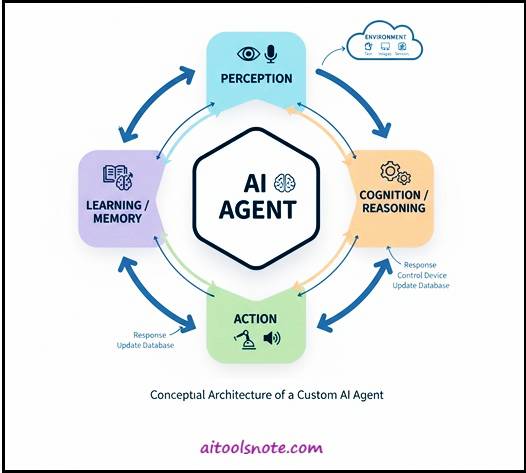
At its heart, an AI agent typically incorporates several interconnected components that work in harmony:
- Perception: The ability to receive and interpret information from its environment (e.g., text input, sensor data, images).
- Cognition/Reasoning: The processing unit where the agent makes decisions, plans actions, and learns from experiences. This often involves machine learning models, rule-based systems, or a combination.
- Action: The capability to perform actions in its environment based on its decisions (e.g., generating a response, controlling a device, updating a database).
- Learning/Memory: The mechanism through which the agent improves its performance over time, often by storing past experiences and adjusting its internal models.
Here’s a simplified diagram illustrating these core components:
Phase 1: Conceptualization and Planning: Defining Your Agent’s Purpose
This initial phase is arguably the most critical. A well-defined purpose is the cornerstone of a successful AI agent. Without it, you risk building a solution that doesn’t truly address a need.
Identify the Problem or Opportunity:
What specific challenge are you trying to solve, or what new opportunity are you trying to seize? Be precise. Instead of “I want an AI for customer service,” consider “I want an AI to answer frequently asked questions about product returns, freeing up human agents for complex issues.”
Define the Agent’s Goal(s):
What measurable outcomes do you expect your agent to achieve?
- Example Goal: Reduce customer service response time by 30%.
- Example Goal: Increase sales conversions by 10% through personalized recommendations.
Outline the Agent’s Scope and Capabilities:
What tasks will the agent perform, and what tasks will it not perform? What information will it need to access? What actions will it be able to take?
- Capabilities: Understand natural language, access a product database, provide order status updates.
- Limitations: Cannot process payments, cannot handle emotionally charged conversations.
Understand Your Target Users/Environment:
Who will interact with the agent? What is their technical proficiency? What are the typical interaction patterns? What systems or platforms will the agent need to integrate with?
Data Requirements:
What kind of data will your agent need to learn from and operate on?
- For a chatbot: Past customer conversations, FAQs, product documentation.
- For a recommendation engine: User browsing history, purchase data, product features.
Ethical Considerations and Responsible AI:
From the outset, consider potential biases in your data, privacy implications, transparency, and fairness. How will your agent behave responsibly? How will you ensure it doesn’t perpetuate harmful stereotypes or make unfair decisions? This is not an afterthought; it’s fundamental.
Phase 2: Data Collection and Preparation: Fueling Your Agent
Data is the lifeblood of any AI system. The quality and quantity of your data will directly impact your agent’s performance.
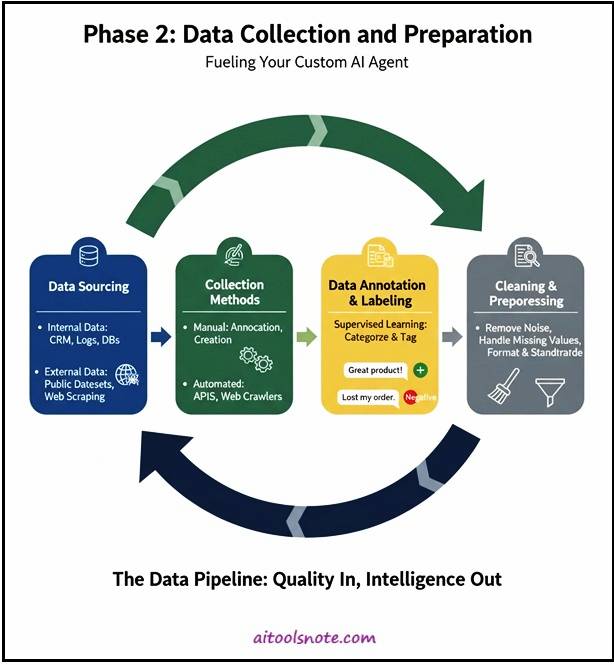
Data Sourcing:
Where will your data come from?
- Internal Data: Databases, CRM systems, chat logs, support tickets, internal documents.
- External Data: Public datasets, web scraping (ensure legal and ethical compliance), third-party data providers.
Data Collection Methods:
- Manual Collection: For niche or highly specific data, manual annotation or creation might be necessary.
- Automated Collection: APIs, web crawlers, real-time data streams.
Data Annotation and Labeling:
For supervised learning models, your data will need to be labeled. For example, if you’re building a sentiment analysis agent, text snippets need to be labeled as “positive,” “negative,” or “neutral.” This can be done manually or with the help of specialized annotation tools and services.
Data Cleaning and Preprocessing:
Raw data is rarely ready for AI training. This step involves:
- Handling Missing Values: Imputing, removing, or flagging.
- Removing Noise and Outliers: Irrelevant information, errors, or extreme values.
- Text Normalization: Lowercasing, stemming/lemmatization, removing stop words, tokenization.
- Feature Engineering: Creating new features from existing ones that might be more informative for the model.
- Data Transformation: Scaling, normalization, encoding categorical variables.
Phase 3: Model Selection and Development: Building the Brain
This is where you choose and train the machine learning models that will power your agent’s intelligence.
Choose the Right AI Paradigm/Models:
The choice depends heavily on your agent’s purpose and data type.
- Rule-Based Systems: For tasks with clearly defined rules and logic (e.g., simple chatbots following a script). Easy to implement but lack flexibility.
- Machine Learning (ML):
- Supervised Learning: For tasks where you have labeled data (e.g., classification, regression).
- Examples: Natural Language Processing (NLP) for text classification (sentiment analysis, intent recognition), image recognition, predictive analytics.
- Models: Support Vector Machines (SVMs), Decision Trees, Random Forests, Gradient Boosting Machines (XGBoost, LightGBM), Neural Networks (NNs).
- Unsupervised Learning: For tasks where you want to find patterns in unlabeled data (e.g., clustering, dimensionality reduction).
- Examples: Customer segmentation, anomaly detection.
- Models: K-Means, DBSCAN, Principal Component Analysis (PCA).
- Reinforcement Learning (RL): For agents that learn through trial and error by interacting with an environment and receiving rewards/penalties.
- Examples: Game AI, robotics, optimization problems.
- Models: Q-learning, Deep Q-Networks (DQN), Proximal Policy Optimization (PPO).
- Supervised Learning: For tasks where you have labeled data (e.g., classification, regression).
- Deep Learning (DL): A subset of ML using neural networks with multiple layers, excelling in tasks involving large, complex data like images, audio, and text.
- Convolutional Neural Networks (CNNs): Excellent for image and video processing.
- Recurrent Neural Networks (RNNs) / Long Short-Term Memory (LSTMs) / Transformers: Ideal for sequential data like natural language and time series. Transformer models (like BERT, GPT) are now state-of-the-art for many NLP tasks.
Select Your Tools and Frameworks:
- Programming Languages: Python is dominant in AI/ML due to its extensive libraries.
- ML Frameworks: TensorFlow, PyTorch, Scikit-learn, Keras.
- Cloud AI Services: AWS Sagemaker, Google Cloud AI Platform, Azure Machine Learning – these offer managed services for training, deploying, and scaling ML models.
- Specialized Libraries: NLTK, spaCy for NLP; OpenCV for computer vision.
Model Training:
- Split Data: Divide your prepared data into training, validation, and test sets.
- Initialize Model: Set up your chosen model architecture.
- Train: Feed the training data to the model, allowing it to learn patterns and adjust its internal parameters (weights and biases).
- Monitor Progress: Use the validation set to track performance during training and prevent overfitting (where the model learns the training data too well but performs poorly on new data).
Model Evaluation and Tuning:
After training, evaluate your model’s performance on the unseen test set using appropriate metrics:
- Classification: Accuracy, Precision, Recall, F1-score, ROC-AUC.
- Regression: Mean Squared Error (MSE), Root Mean Squared Error (RMSE), R-squared.
- Natural Language Processing: BLEU score (for translation), Perplexity (for language models).
Hyperparameter Tuning: Adjust parameters that are not learned from data (e.g., learning rate, number of layers, batch size) to optimize model performance. Techniques include grid search, random search, or Bayesian optimization.
Phase 4: Integration and Deployment: Bringing Your Agent to Life
Once your model is trained and performing well, it’s time to integrate it into your desired environment and make it accessible.
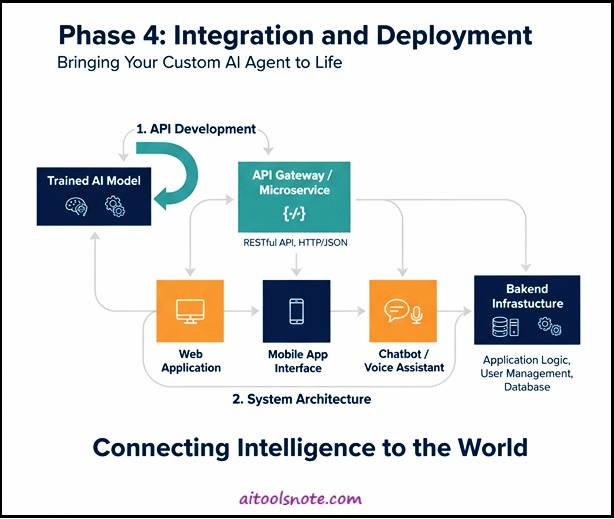
API Development:
Wrap your trained model in an API (Application Programming Interface) to allow other applications to interact with it. RESTful APIs are common, enabling communication over HTTP.
System Architecture:
Design how your AI agent will fit into your existing infrastructure. This might involve:
- Frontend: User interface (web app, mobile app, chatbot interface).
- Backend: Application logic, database, API gateway.
- Model Server: A dedicated server to host your trained AI model.

Choose a Deployment Strategy:
- On-Premise: Hosting the agent on your own servers. Offers maximum control but requires significant infrastructure management.
- Cloud Deployment: Utilizing cloud providers (AWS, Google Cloud, Azure) for hosting.
- Virtual Machines (VMs): Spin up virtual servers to host your agent.
- Containerization (Docker, Kubernetes): Package your agent and its dependencies into portable containers for consistent deployment across different environments. Kubernetes orchestrates these containers, managing scaling and high availability.
- Serverless Functions (AWS Lambda, Google Cloud Functions): Run your agent’s code in response to events without managing servers. Cost-effective for intermittent workloads.
- Managed AI Services: Cloud providers offer specialized services for deploying and managing ML models, often simplifying the process.
Security Considerations:
- API Security: Implement authentication (API keys, OAuth) and authorization to control access to your agent.
- Data Encryption: Encrypt data at rest and in transit.
- Vulnerability Management: Regularly scan for and address security vulnerabilities.
Phase 5: Monitoring, Maintenance, and Iteration: The Ongoing Journey
Deployment is not the end; it’s the beginning of your agent’s operational life. AI agents require continuous monitoring and refinement.
Performance Monitoring:
- Operational Metrics: Track uptime, response times, error rates, resource utilization (CPU, memory).
- AI-Specific Metrics: Monitor the agent’s accuracy, precision, recall, and other relevant performance indicators in real-world scenarios.
- User Feedback: Collect direct feedback from users to identify areas for improvement.
Model Drift Detection:
Over time, the real-world data your agent encounters may diverge from the data it was trained on. This “data drift” can degrade performance. Monitor key data distributions and model predictions to detect drift.
Retraining and Updates:
When performance degrades or new data becomes available, your agent will need to be retrained. Establish a regular retraining schedule or trigger retraining based on performance thresholds or detected drift.
- Continuous Learning: Implement mechanisms for your agent to learn incrementally from new data, if appropriate, without full retraining.
A/B Testing:
When implementing significant changes or new model versions, use A/B testing to compare the performance of the old and new agents in a live environment before fully rolling out the update.
Scalability:
As usage grows, ensure your infrastructure can scale to meet demand. This might involve horizontal scaling (adding more instances of your agent) or optimizing your code and models for efficiency.
Advanced Concepts and Best Practices
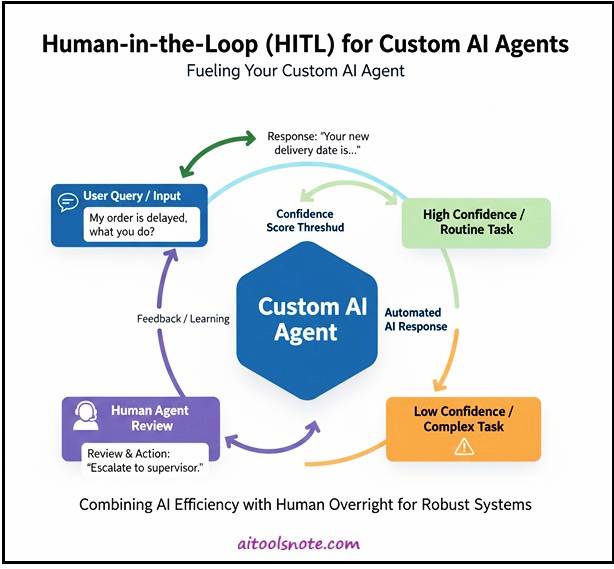
Human-in-the-Loop (HITL):
For complex or critical tasks, it’s often beneficial to integrate human oversight. The AI agent can handle routine tasks, flagging unusual cases or difficult queries for human review. This improves accuracy and builds trust.
Explainable AI (XAI):
As AI models become more complex (“black boxes”), understanding why an agent makes a particular decision becomes crucial, especially in sensitive domains. XAI techniques aim to make AI decisions more transparent and interpretable.
Version Control and MLOps:
Treat your AI models and data like software. Use version control (Git) for code and model artifacts. Implement MLOps (Machine Learning Operations) practices for automating the entire ML lifecycle: data collection, model training, deployment, and monitoring. This ensures reproducibility, collaboration, and efficient management.
Ethical Guidelines and Governance:
Beyond initial ethical considerations, establish ongoing governance for your AI agent. Regularly audit its behavior, assess its impact, and ensure compliance with relevant regulations (e.g., GDPR, HIPAA).
Resource Management:
Training and running AI agents can be computationally intensive. Efficiently manage your computing resources (GPUs, TPUs) and storage to optimize costs and performance.
Conclusion
Creating a custom AI agent is a challenging yet incredibly rewarding endeavor. It allows you to harness the power of artificial intelligence to solve specific problems with precision and innovation. By carefully planning, diligently preparing your data, thoughtfully designing your models, and continuously monitoring your agent’s performance, you can build intelligent systems that truly transform how you operate and interact with the world.
The journey of building an AI agent is iterative, requiring continuous learning and adaptation. Embrace the process, leverage the vast open-source tools and cloud capabilities available, and prepare to unlock new frontiers of tailored intelligence. Your custom AI agent is not just a piece of software; it’s a strategic asset that can drive efficiency, enhance user experiences, and provide a competitive edge in an increasingly AI-driven world.
References
What are AI agents? Definition, examples, and types | Google Cloud
AI agents — what they are, and how they’ll change the way we work – Source
What are AI Agents?- Agents in Artificial Intelligence Explained – AWS – Updated 2025
Seizing the agentic AI advantage | McKinsey
You may also go through: GPT-5.4 vs Claude Sonnet 4.6: Which Is Better for AI Agents and Automation?
How to Use n8n Webhooks Locally on Windows 11/10 (Docker & ngrok)